Beyond the Launch: Hardware Lifecycle Value Management
By Kevin, Senior Hardware Product Manager
4/15/2026
Here is my playbook for managing hardware value from the whiteboard to the recycling bin, based on the rigorous principles of full-lifecycle value management.
Phase 1: Concept Definition (The "Why")
The Equation: F ↑ \ C ↑ (Maximize Functionality, Accept Initial Investment)
Everything starts here. In a startup, the temptation is to build a "Swiss Army Knife" because you think more features equal more sales. My job is to rigorously identify and define core user needs.
The Focus: Ideation, requirement definition, and identifying the true market pull.
User Value: Ensuring the product actually solves a painful problem for the core demographic.
Value Management: At this stage, we are rapidly increasing the theoretical Functionality (F ↑ ). Because we are in R&D, Cost (C ↑ ) is increasing. As a PM, I must ensure that the exponential value of the problem we are solving vastly outweighs the burn rate of our initial investment. We don't just build; we build what matters.
Phase 2: Development & Engineering (The "How")
The Equation: F ↑ \ C → (Refine Functionality, Lock the Cost)
This is where dreams hit the reality of physics and finance. We move into EVT (Engineering Verification Test) and DVT.
The Focus: Design optimization, relentless prototype testing, and commercial planning.
User Value: Delivering reliable functionality and a seamless, optimized user experience. A great concept is useless if the prototype feels cheap or crashes.
Value Management: Here, the PM must become the ruthless guardian of the BOM (Bill of Materials). We are still tweaking and improving the product's function (F ↑ ), but we must forcefully cap the cost (C → ). If an engineer wants to add a $2 sensor that only benefits 5% of users, I kill it. We must maintain target margins before we even hit the factory floor.
Phase 3: Production & Manufacturing (The Scale)
The Equation: F ↑ / C ↓ (Elevate Quality, Drive Down Costs)
Moving into PVT (Production Verification Test) and Mass Production (MP). The product leaves the lab and enters the real world.
The Focus: High-efficiency manufacturing, rigorous QA, and aggressive cost reduction through DFM (Design for Manufacturing).
User Value: Providing a high-quality, defect-free product at a reasonable price point.
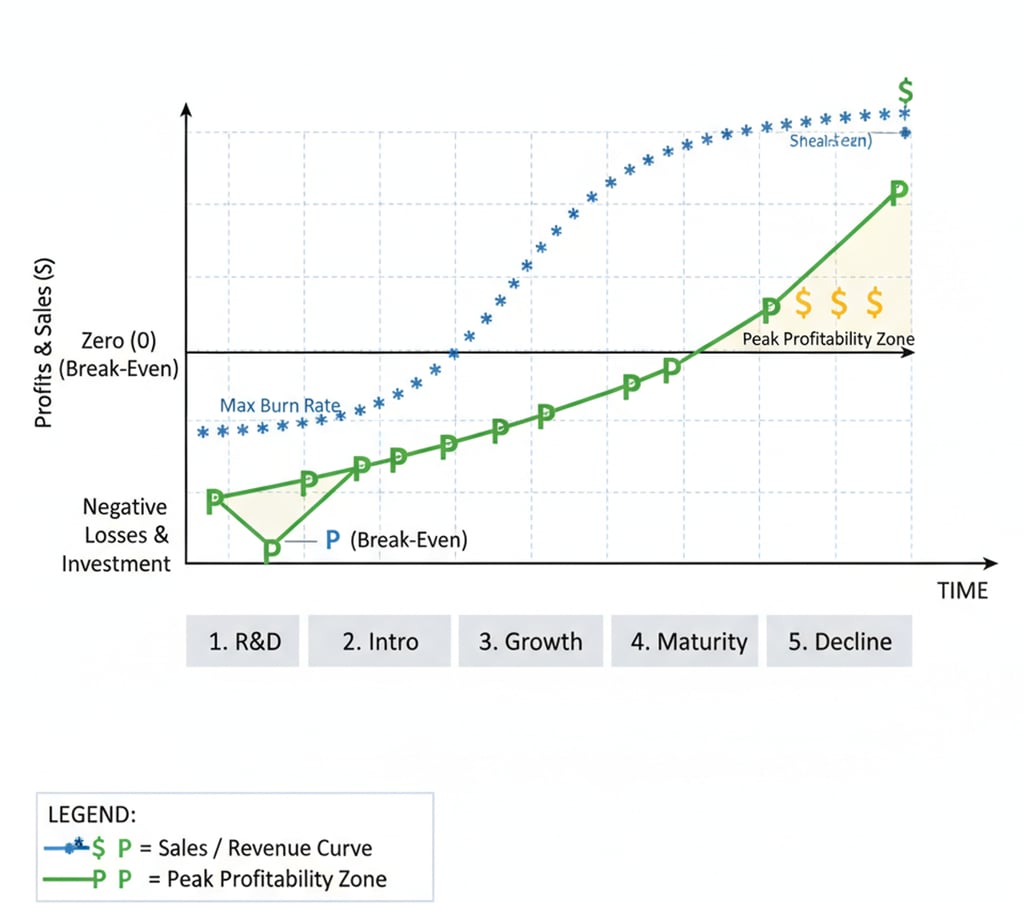
Value Management: This is the inflection point on the profit curve. Through economies of scale, better tooling, and improved factory yields, the effective quality and functionality delivered to the market increases (F ↑ ), while our per-unit cost drops (C ↓ ). A great PM works directly with supply chain partners to shave pennies off assembly time—because at scale, pennies turn into millions.
Phase 4: Sales, Installation & O&M (The Cash Cow)
The Equation: F → / C ↓ (Maintain the Experience, Optimize Operations)
The product is in the market, transitioning from Growth to Maturity. The R&D team has likely moved on to "Version 2.0," but the lifecycle PM knows this is where the actual money is made.
The Focus: Efficient packaging, supply chain logistics, customer satisfaction, and product reliability in the field.
User Value: Fast delivery, out-of-the-box satisfaction, and continuous value creation (often through OTA software updates or reliable customer support).
Value Management: The hardware features are locked in (F → ), but our job isn't done. We relentlessly squeeze the operational costs (C ↓ ). We negotiate better shipping rates, reduce packaging size to fit more units on a pallet, and use field data to write better troubleshooting guides, dropping customer service costs. The wider the gap between F and C here, the higher the profit peak.
Phase 5: Disposal & EOL (The Graceful Exit)
The Equation: F ↓ / C ↓ (Sunset Features, Slash Overhead)
Eventually, every hardware product declines. Failing to manage the End-of-Life (EOL) phase can bleed a startup’s profits through lingering server costs and legacy support.
The Focus: Responsible disposal, recycling, value recovery, and transitioning users to the next generation.
User Value: Minimizing environmental impact (ESG) and providing upgrade opportunities to loyal users.
Value Management: We intentionally phase out unnecessary, costly background functions (F ↓ )—like sunsetting legacy cloud servers—to massively drop our maintenance costs (C ↓ ). We might offer a trade-in program, which recovers component value and locks the user into our next product lifecycle.
The PM's Ultimate Mandate
Hardware is unforgiving. If you only focus on Phase 2 (Engineering), you will build a beautiful product that bankrupts you in Phase 3 (Manufacturing). If you ignore Phase 4 (O&M), your margins will be eaten alive by logistics and returns.
To be a successful hardware product manager isn't just about writing PRDs and arguing with engineers. It is about acting as the Chief Value Officer for your product. By applying the V=F / C (Value = Function / Cost) lens to every single stage—from the spark of an idea to the recycling plant—you ensure that your startup doesn't just launch a product, but builds a sustainable, profitable business.
In the hardware startup ecosystem, there’s a dangerous myth that the finish line is Launch Day. Founders pop champagne when the first container leaves the factory, mistakenly believing the hardest part is over.
As a Senior Hardware PM(Project Manager) who has lived in the trenches of product development, I can tell you that launching is just leaving Base Camp. True product management isn’t just about getting a piece of plastic and silicon to turn on; it’s about Value Management across the entire lifecycle of the product.
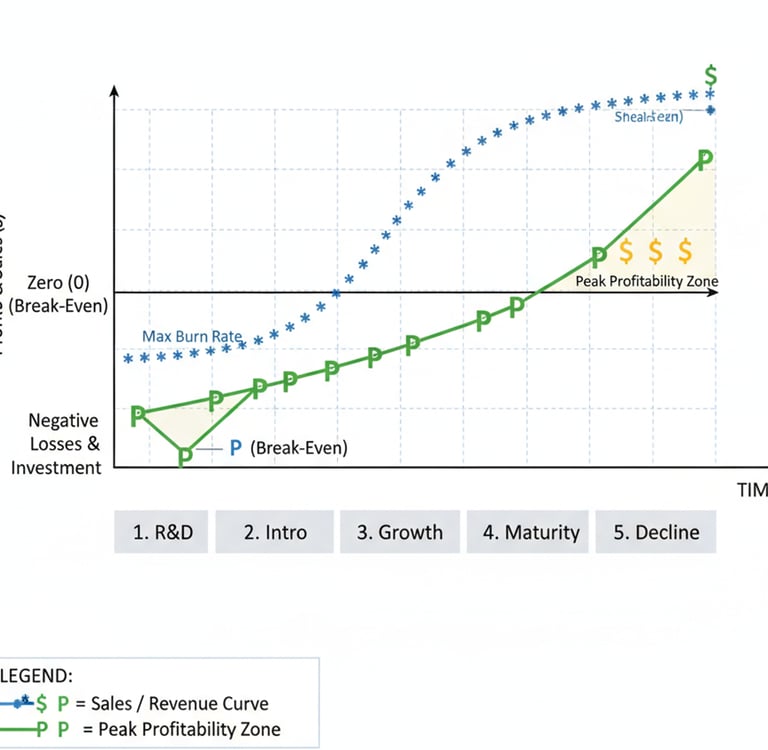
If you look at the classic lifecycle graph (Investment vs. Profit over time), startups spend their early days deep in the "valley of death"—burning cash during R&D. The only way to climb out of that valley, cross the introduction phase, and ride the sweet, profitable curves of Growth and Maturity is by obsessively managing the Value Equation: V= F / C (Value = Function / Cost)
Email Us
Flat 2401, Industrial Building, San Po Kong, Hong Kong 999077